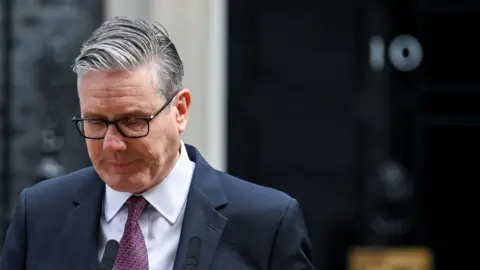
Sir Keir Starmer Resigns as British PM
Sir Keir Starmer today announced his resignation as Prime Minister of the United Kingdom, marking a significant shift in the nation's political landscape.
Sir Keir Starmer today announced his resignation as Prime Minister of the United Kingdom, marking a significant shift in the nation's political landscape. The announcement came from 10 Downing Street, leaving the Labour Party and the country to grapple with the immediate implications of his departure. Starmer's premiership, which began after a decisive general election victory, concludes amidst a period of considerable domestic and international challenges.
His resignation follows an intense period of scrutiny regarding his government's handling of economic policy and ongoing industrial disputes. Sir Keir Starmer assumed the leadership of the Labour Party in April 2020. Before entering Parliament, Starmer served as the Director of Public Prosecutions and Head of the Crown Prosecution Service from 2008 to 2013. He became the Member of Parliament for Holborn and St Pancras in 2015. His career as a barrister, specializing in human rights, also shaped his public profile prior to his political ascent. These experiences defined his approach to governance, emphasizing legal reform and social justice.
Political analysts immediately weigh the profound impact of Starmer's resignation on the Labour Party. This unexpected departure triggers a leadership contest within the party, initiating a scramble for succession. Experts from the London School of Economics suggest the timing creates an opportunity for new policy directions but also risks internal division during a critical period for the government. The Conservative Party, currently in opposition, will undoubtedly seek to capitalize on the instability, potentially calling for an early general election. The financial markets show an immediate reaction, with the pound experiencing fluctuations as investors assess the implications of the political uncertainty.
British political history features several instances of Prime Ministers resigning mid-term. Margaret Thatcher resigned in November 1990, and Tony Blair stepped down in June 2007, both amid considerable political pressure. More recently, Boris Johnson resigned in July 2022, followed by Liz Truss in October 2022, each departure precipitating a leadership contest within their respective parties. These historical precedents underscore the gravity of a Prime Ministerial resignation and the constitutional processes that follow. The United Kingdom's unwritten constitution dictates that the monarch appoints a new Prime Minister who commands the confidence of the House of Commons.
The immediate future sees the Labour Party enter a period of intense internal campaigning to select a new leader. This process typically involves nominations from Members of Parliament, followed by a vote among party members. The new leader will then face the daunting task of uniting the party and addressing the pressing issues facing the country, including economic growth, public services, and Britain's role on the global stage. The speed and outcome of this leadership election will significantly shape the trajectory of British politics for the remainder of the decade.