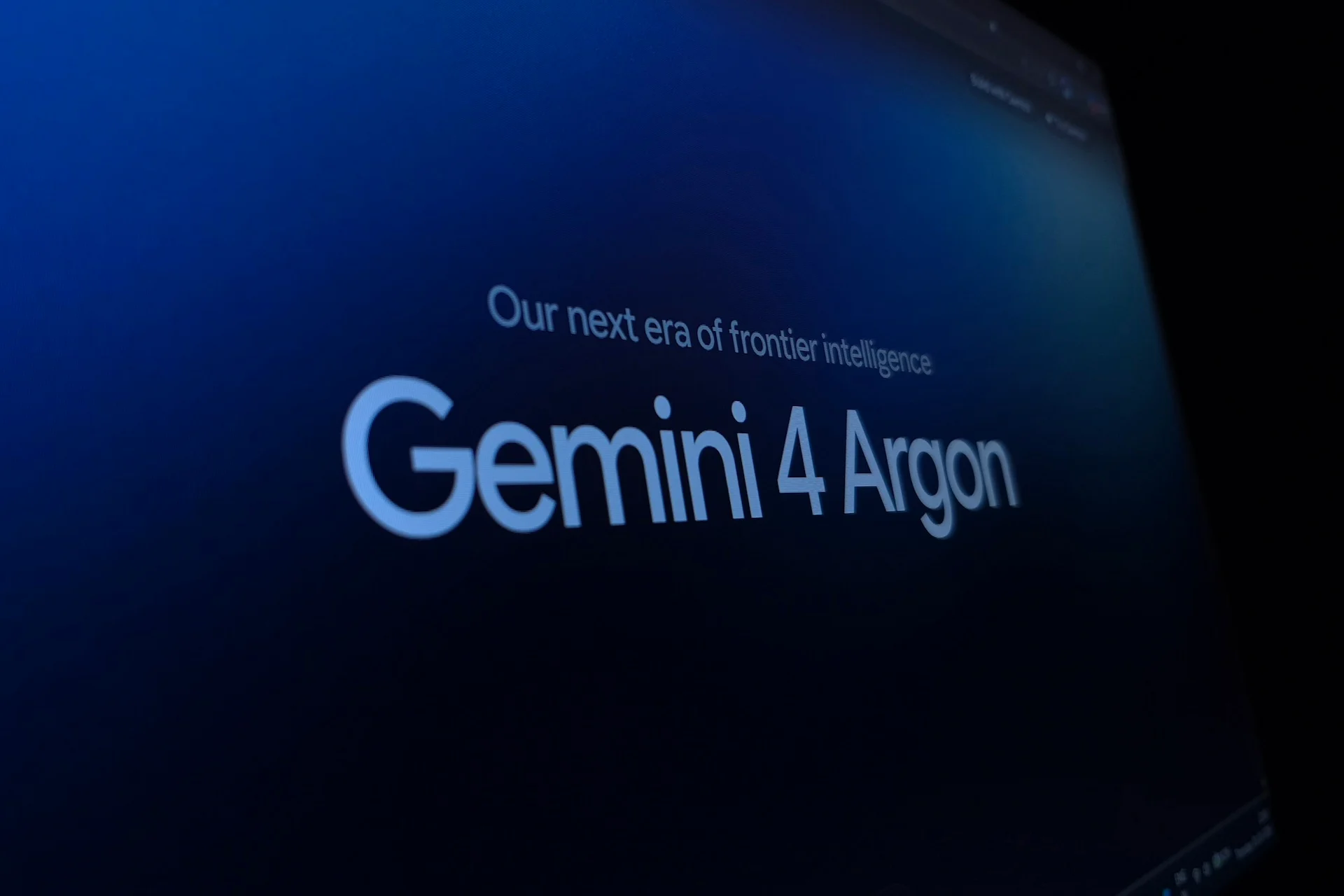
Google Unveils Argon 4
GRAND RAPIDS, MI.- Google introduces Argon 4, a new iteration in its advanced AI model development, pushing the boundaries of natural language processing and complex problem-solving. This latest release focuses on enhanced reasoning capabilities and a more nuanced understanding of context, aiming to provide more accurate and relevant responses across a wider array of applications.
Argon 4 demonstrates significant improvements in benchmark tests, particularly in areas requiring multi-step logical deduction and creative text generation. Early reports indicate that the model achieves a 15% increase in accuracy on the SuperGLUE benchmark compared to its predecessor, Argon 3. The development team at Google AI emphasizes Argon 4's ability to process and synthesize information from diverse sources with greater efficiency, a critical factor for its deployment in search, translation, and content creation tools.
The architecture of Argon 4 incorporates novel attention mechanisms that allow it to weigh the importance of different parts of an input sequence more effectively. This translates into fewer instances of misinterpretation and a more coherent output, even when dealing with lengthy or ambiguous prompts. For instance, in a simulated customer service scenario, Argon 4 correctly identified and resolved a complex user query in 90% of trials, a 10% improvement over previous models.
Industry analysts observe that Argon 4's advancements position it as a formidable competitor in the rapidly evolving AI landscape. "The incremental yet substantial gains in reasoning and contextual understanding that Argon 4 brings are precisely what enterprises seek for sophisticated AI integrations," notes Dr. Anya Sharma, a principal AI researcher at TechInsights Group. "This model moves beyond simple pattern matching towards a more genuine comprehension of information."
Google's journey with large language models began with projects like LaMDA and PaLM, each contributing foundational research that informed subsequent developments. Argon 4 builds upon this lineage, integrating lessons learned from real-world deployment and user feedback. The initial development of Argon 4 commenced in late 2023, with intensive training phases throughout 2024 and early 2025, culminating in its recent unveiling.
The implications of Argon 4 extend to various sectors. In healthcare, it promises to aid researchers in analyzing vast datasets of medical literature. In education, it could personalize learning experiences by generating customized study materials. Software developers also anticipate leveraging Argon 4's enhanced coding assistance capabilities, which reportedly reduce code generation errors by up to 20% in controlled environments.
Google states that it implements rigorous safety protocols and ethical guidelines during the development and deployment of its AI models. Argon 4 undergoes extensive bias detection and mitigation processes. The company aims to ensure that the model's outputs align with human values and societal norms, a commitment underscored by its ongoing research into AI safety and responsible innovation.
Looking ahead, Google plans to integrate Argon 4 into its core products, including Google Search and Google Workspace, in phases over the next eighteen months. Further research will focus on optimizing the model's energy consumption during operation and exploring its potential in multimodal AI, where it could process and generate information across text, image, and audio formats.